Your Network Devices Are Running Vulnerable Firmware. You Just Don't Know It.
Servers get patched. Workstations get patched. But firmware on your switches, routers, firewalls, and access points? That's the blind spot that attackers know about — and most security teams don't.
ConnectMyAssets is the only platform that gives network teams real firmware-based vulnerability tracking — including End-of-Life detection — across their entire network infrastructure.
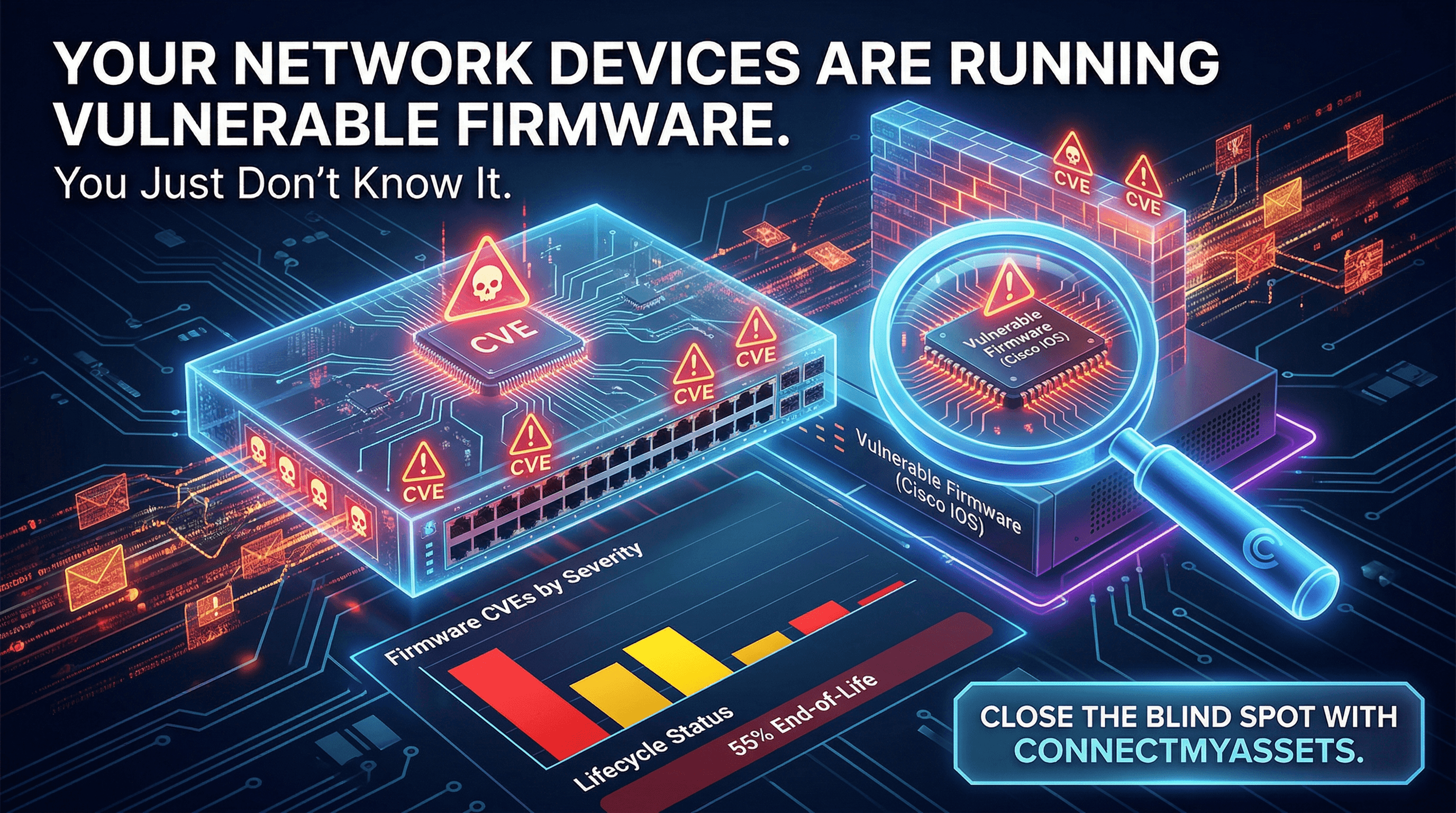
Your Network Devices Are Running Vulnerable Firmware. You Just Don't Know It.
The Blind Spot in Enterprise Security That Attackers Already Found
1. The Forgotten Layer of Your Attack Surface
Every security team has a vulnerability management process. Qualys scans servers. Tenable watches endpoints. SIEM collects logs. Patch Tuesday is on every calendar.
But ask your team a simple question: which of your network devices are running firmware with a known critical CVE right now?
Most organizations cannot answer that question. Not because they don't care — but because the tooling was never built for it.
Network infrastructure is the skeleton of your organization. Switches carry every packet. Routers connect every site. Firewalls enforce every policy. Access points are the entry point for every wireless device in your buildings. These devices run 24/7, they're rarely rebooted, and their firmware versions are almost never tracked with the same rigor as software on servers or endpoints.
Access points deserve a special mention here. They are often deployed in large numbers, managed through separate wireless controllers or cloud platforms, and quietly forgotten once they're online. Yet they run full embedded firmware stacks — and they sit at the physical edge of your network, reachable by anyone with a Wi-Fi adapter in range.
The uncomfortable truth: a switch or access point that has been running the same firmware for 3 years almost certainly has at least one publicly known critical vulnerability. The question is whether anyone in your organization knows which one.
2. Why Firmware Is Different — and Harder to Track
Traditional vulnerability scanners were built around operating systems and applications. They query a known software inventory, cross-reference a CVE database, and output a list.
Network device firmware breaks every one of those assumptions:
- No standard query interface — firmware versions are not exposed through scanning protocols the way OS versions are
- Fragmented versioning schemes —
15.2(4)M,ArubaOS 10.4.0.3,FortiOS 7.4.1— none of these map cleanly to CVE identifiers without significant vendor-specific logic - Sub-version sensitivity — the same firmware branch can be vulnerable in one sub-version and patched in the next
- Protocol heterogeneity — many devices only expose version info via SSH CLI, proprietary REST APIs, or NETCONF, each varying per vendor
- Multi-vendor complexity — Cisco + Aruba + Fortinet + Juniper + Ubiquiti + Ruckus multiplies this fragmentation exponentially, especially when wireless controllers manage hundreds of APs each running their own firmware version
The result? Most organizations maintain zero structured visibility into the firmware security posture of their network infrastructure. At best, a spreadsheet someone updated six months ago.
3. The Lifecycle Problem: EoL Devices Hiding in Plain Sight
Firmware vulnerabilities are one part of the problem. End-of-Life (EoL) hardware is the other — and they're closely connected.
When a vendor declares a device End-of-Life, they stop issuing firmware updates. Any CVE discovered after that date will never be patched. The device becomes permanently vulnerable by design.
Yet in most enterprise environments, EoL devices continue to operate for years after their lifecycle ends. The reasons are always the same: budget cycles, migration complexity, and the fact that the switch "still works" and nobody noticed it aged out. Access points are particularly prone to this — deployed in ceiling tiles across dozens of floors, they tend to outlive their support window simply because no one is tracking them individually.
A device that is EoL is not just aging infrastructure — it's an unpatched vulnerability with a permanent status. No fix is coming. The only resolution is replacement.
The compounding problem: lifecycle information is scattered across vendor portals, product bulletins, and PDFs that change without notice. There is no single authoritative feed. Tracking EoL across a multi-vendor environment manually is not a realistic operational task.
Most organizations discover their EoL exposure in one of two ways: during a compliance audit, or after an incident. Neither is a good time to find out.
4. CVE Tracking Without Firmware Context Is Just Noise
Security teams receive CVE feeds. They subscribe to vendor advisories. They have SIEM rules that fire on new critical CVEs. But without knowing exactly which firmware version each device is running, every CVE alert is meaningless.
Is CVE-2025-20352 — the critical SNMP zero-day affecting over 2 million Cisco devices — actually affecting your network?
You can only answer that if you know:
- Which devices in your infrastructure run Cisco IOS or IOS-XE
- The exact firmware version running on each of those devices
- Whether those versions fall within the affected range in the advisory
- Whether a patched firmware has already been deployed
Without that inventory, security teams are left choosing between two bad options: treat every CVE as potentially affecting every device (alert fatigue, operational paralysis), or assume devices are fine because nobody reported a problem (blind optimism).
Neither is a security posture. Both are liabilities.
5. What Real Firmware-Based Vulnerability Management Looks Like
Effective firmware security management requires three capabilities working together:
Accurate, real-time firmware inventory
You need to know, for every device on your network, the exact firmware version — not an estimate, not what was deployed last quarter. The inventory must update automatically as devices are patched or replaced, and cover the full vendor heterogeneity of your environment.
CVE correlation at the firmware level
A CVE affecting "Cisco IOS" is not useful. A CVE affecting "Cisco IOS 15.2(4)M through 15.6(3)M" is. The vulnerability engine must map each device's exact firmware version to the specific affected ranges published in vendor advisories — and surface only the CVEs that are genuinely relevant to your inventory.
EoL tracking per device
Each device must carry its lifecycle status: currently supported, approaching EoL, or already past it. This context transforms vulnerability data into actionable prioritization. A device that is EoL with two critical CVEs is fundamentally different from a supported device that can be patched.
6. How ConnectMyAssets Solves This
ConnectMyAssets built the vulnerability module that network teams have been missing — and we are the only platform on the market that approaches network device security this way.
Automatic firmware discovery across your entire infrastructure
ConnectMyAssets connects to every device in your network infrastructure through a proprietary multi-vendor intelligence engine — purpose-built to handle the full diversity of manufacturers, firmware generations, and communication models found in real enterprise environments. Switches, routers, firewalls, and access points alike. No agents. No manual inventory. No spreadsheets. The CMDB stays current automatically, across multi-vendor environments spanning Cisco, Aruba, Fortinet, Juniper, Ubiquiti, Ruckus, and many others — including wireless controllers managing large AP deployments.
Firmware-matched CVE scoring
Our vulnerability engine cross-references each device's firmware version against an actively maintained CVE database with vendor-specific normalization. We don't just surface CVEs that mention a vendor name — we match the exact affected version ranges. The result: a list of devices that are genuinely exposed, with CVSS scores and remediation guidance. Not a list of devices that might be affected.
When a new critical CVE is published — like CVE-2025-20352, the SNMP zero-day that exposed over 2 million Cisco devices — ConnectMyAssets immediately tells you which devices in your infrastructure are running affected firmware. Not hypothetically. Concretely.
End-of-Life visibility built in
Every device in your ConnectMyAssets inventory carries its lifecycle status. Devices approaching End-of-Life are flagged proactively. Devices that have already crossed their EoL date appear in a dedicated view, so you can drive replacement planning before operating unsupported infrastructure indefinitely.
Combined with firmware CVE data, this gives you a risk matrix that didn't exist before: which devices are EoL, which carry unpatched CVEs, and which are both — the ones that belong at the top of your remediation backlog immediately.
The Bottom Line
Network infrastructure is too critical to manage with spreadsheets and vendor PDFs. Firmware vulnerabilities are real, they are actively exploited, and they affect devices that your existing security tooling was never designed to cover.
The organizations that will be resilient are the ones that close this gap before an attacker finds it. That means knowing exactly what firmware every device is running, exactly which CVEs affect it, and exactly which devices are past their supported lifecycle.
That's what ConnectMyAssets was built to give you.