Switch Management: Compliance as a Key to Freedom from Closed Ecosystems
In today’s networked enterprises, the real challenge isn’t just connecting devices — it’s governing complexity.
With multiple vendors, evolving firmware, and growing compliance requirements, IT teams often lose visibility and control.
This article explores how ConnectMyAssets brings back operational freedom through open standards, compliance, and interoperability, breaking away from the limitations of vendor-locked solutions.
1. Switch management — a strategic challenge
In modern enterprise environments, switch management is no longer a matter of simple connectivity.
It has become a strategic governance topic involving:
- Thousands of devices to maintain
- Continuous software and security updates
- Strict configuration standards to enforce
For years, the industry relied on vendor-specific ecosystems — convenient, yes, but closed by design.
2. The trap of proprietary solutions
Platforms like Aruba Central or Cisco DNA Center provide strong visibility and automation — but only within their own ecosystem.
They typically enforce:
- Vendor-specific licensing models
- Cloud dependencies tied to the manufacturer
- Operational lock-in that increases with every new deployment
The result: the organization gradually loses control over its network assets, and its operational model becomes dictated by the vendor — not by its own strategy.
This vendor lock-in makes management more expensive, less flexible, and incompatible with multi-vendor environments — which are the norm in large industrial groups.
3. The ConnectMyAssets approach — open, neutral, and centralized
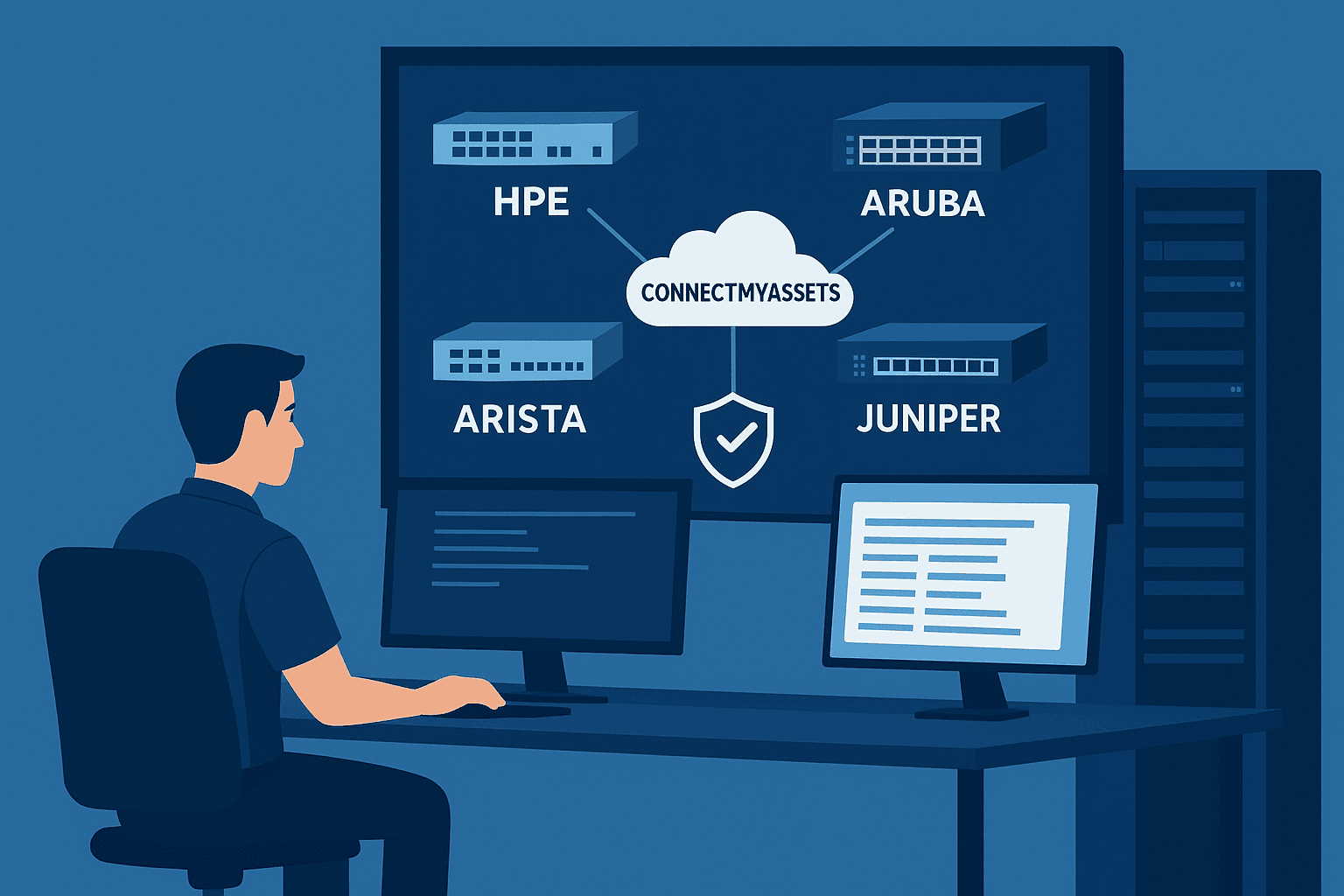
ConnectMyAssets offers a radically different vision: an open, multi-vendor network management platform that unifies visibility, documentation, and compliance across all network devices — regardless of brand or model.
Key strengths
- Interoperability: Supports major vendors (Cisco, HPE, Aruba,Arista, Juniper, etc.) via APIs, SSH, SNMP.
- Unified visibility: One dashboard for all switches across sites.
- Neutral automation: No vendor-tied licenses or proprietary lock-in.
- Seamless integration: Connects with CMDB, monitoring, and ITSM tools.
ConnectMyAssets becomes a single source of truth for network infrastructure while preserving technological independence.
4. Compliance — a universal standard in a heterogeneous world
Compliance is central to the ConnectMyAssets model. It continuously ensures every switch configuration aligns with enterprise policies:
- Naming conventions
- VLANs and QoS profiles
- SNMP and NTP settings
- Firmware and patch levels
- Port-security and ACLs
Benefits
- Instant detection of configuration drift
- Consistent security enforcement across vendors
- Simplified, audit-ready documentation
- Automated remediation or guided correction workflows
Compliance is not merely control — it’s trust, consistency, and operational resilience. It becomes the unifying language across diverse network ecosystems.
5. A sustainable and future-ready model
By embracing open standards and interoperable architectures, organizations can:
- Manage multi-site, multi-vendor environments from a single platform
- Simplify compliance and maintenance operations
- Reduce licensing and training costs
- Strengthen technological sovereignty
This is the future of network management: open, automated, and sustainable.
Conclusion
The era of isolated, vendor-dependent networks is over.
The objective is not to buy into another closed ecosystem — it is to reclaim control over your infrastructure.
With an open platform like ConnectMyAssets, compliance becomes a unifying force and network governance returns to the organization — not the manufacturer.