Understanding VLAN Types and Why Segmentation Matters
In modern network design, Virtual Local Area Networks (VLANs) are essential for improving performance, enhancing security, and simplifying management. By segmenting traffic into logical groups, VLANs isolate network domains, reduce broadcast traffic, and give administrators granular control over data flow.
Types of VLANs
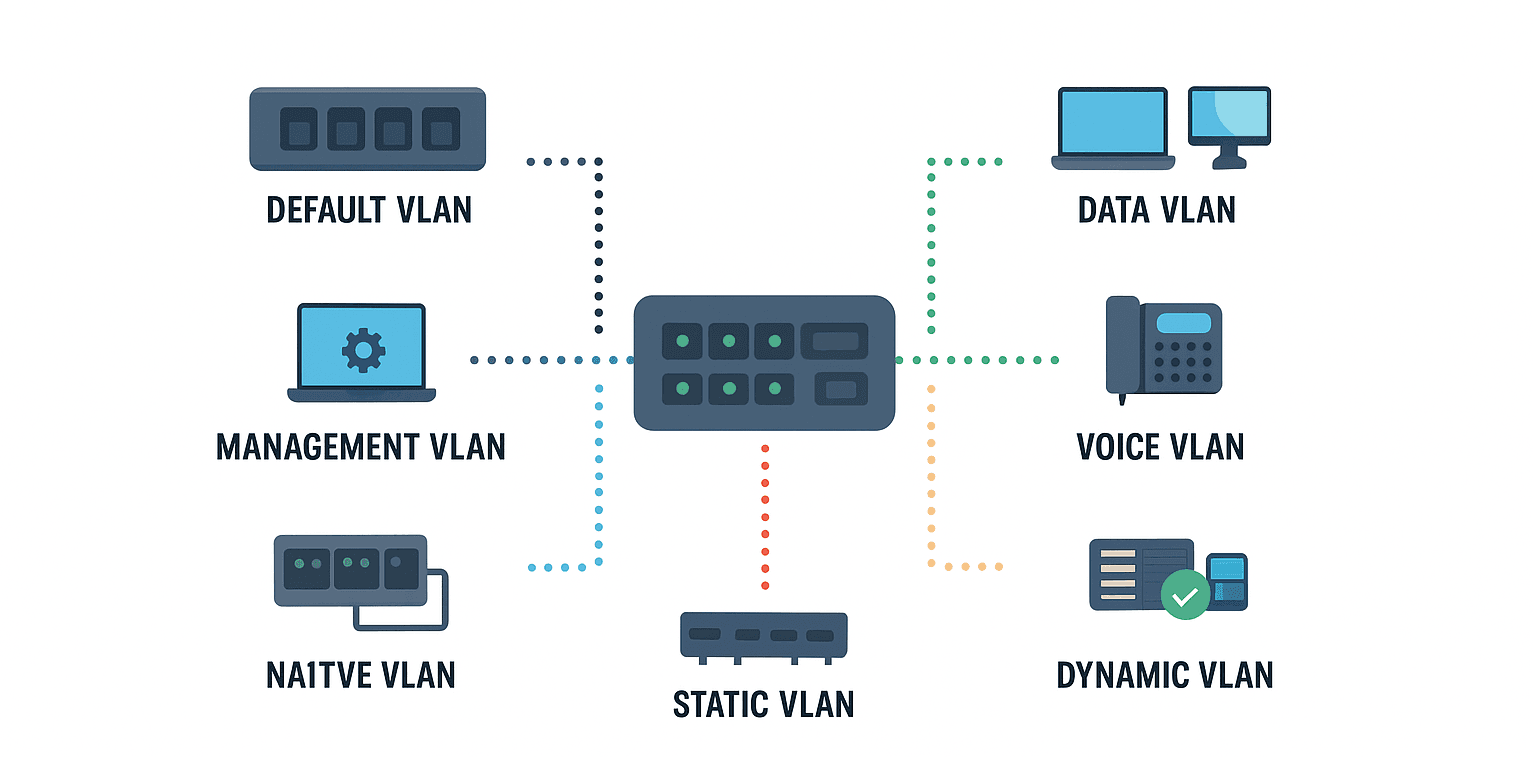
1. Default VLAN
Every switch comes with a default VLAN (typically VLAN 1).
All ports belong to it until manually reassigned.
It cannot be deleted or renamed, and it often carries untagged management or control traffic.
2. Data VLAN (User VLAN)
Carries user-generated traffic such as emails, web access, and file transfers.
Separating user data from voice or management traffic helps maintain performance and improve troubleshooting visibility.
3. Voice VLAN
Dedicated to VoIP (Voice over IP) devices.
Voice VLANs are optimized using Quality of Service (QoS) parameters to prioritize latency-sensitive packets, ensuring crystal-clear communication even under heavy network load.
4. Management VLAN
Used for network administration—providing secure access to switch, router, and firewall management interfaces.
Keeps management traffic isolated from user or guest networks, minimizing the attack surface.
5. Native VLAN
Handles untagged traffic on trunk ports.
The native VLAN acts as the default path for frames that arrive without VLAN tags—useful for backward compatibility, but should be configured carefully to prevent VLAN hopping attacks.
6. Private VLAN (PVLAN)
Used primarily in data centers to isolate devices within the same subnet.
Enhances internal security by allowing or denying inter-device communication, while keeping shared upstream connectivity.
7. Static VLAN
Ports are manually assigned to specific VLANs by network administrators.
Ensures consistent topology control and predictable security zones—ideal for stable environments.
8. Dynamic VLAN
Assignments are made automatically based on device attributes such as MAC address or authentication via RADIUS.
Simplifies onboarding for mobile and flexible devices, adapting automatically to user roles or policies.
Why VLAN Segmentation Is Crucial
Proper VLAN segmentation:
- Reduces broadcast storms and network congestion.
- Strengthens security boundaries between departments (e.g., separating HR from Finance).
- Enhances Quality of Service (QoS) for sensitive applications like VoIP or video conferencing.
- Simplifies troubleshooting by isolating traffic flows.
Without segmentation, networks can quickly become flat, insecure, and inefficient.
Boosting VLAN Visibility with ConnectMyAssets
While VLANs offer structure, managing them at scale can become complex.
This is where ConnectMyAssets makes a difference.
ConnectMyAssets provides centralized visibility and intelligent automation for your VLAN architecture.
Key Benefits:
- Unified VLAN Inventory: Instantly visualize VLAN assignments across your infrastructure.
- Simplified Deployment: Deploy new VLANs or modify existing ones through an intuitive interface—no manual switch-by-switch configuration.
- Enhanced Compliance: Ensure consistent segmentation and policy enforcement across multi-site networks.
- Proactive Monitoring: Detect misconfigurations or overlapping VLANs before they cause disruptions.
With ConnectMyAssets, network engineers can maintain order, visibility, and agility, ensuring that VLAN segmentation truly delivers its full potential.
Final Thoughts
VLANs are more than just a way to divide a network—they are the foundation of secure, efficient, and scalable infrastructure.
By combining strategic segmentation with modern automation tools like ConnectMyAssets, organizations can achieve the perfect balance between control and flexibility.